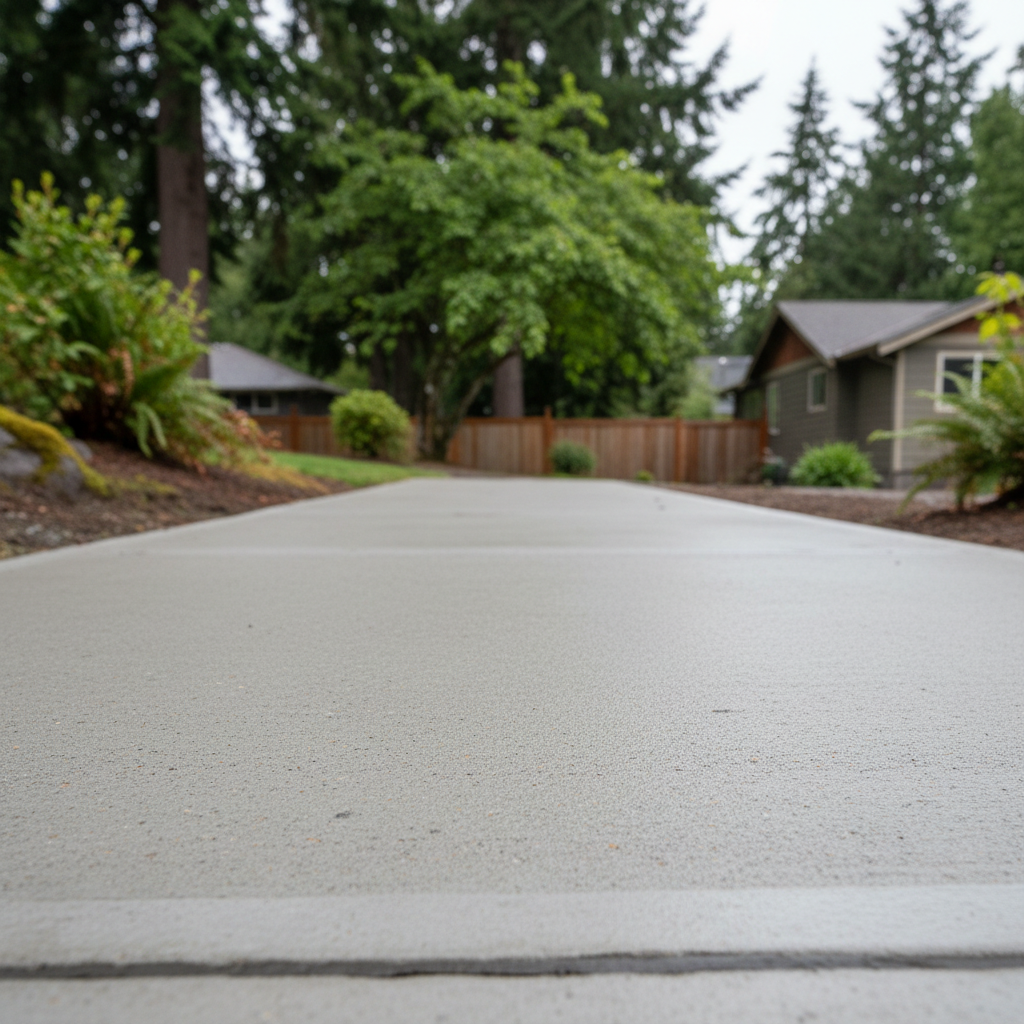
Let us talk about concrete sidewalks. As a local contractor with Allied Concrete Solutions, I have seen many questions from homeowners around Redmond. It is not always as simple as pouring some concrete and then calling it a day. This is especially true with our Pacific Northwest weather as well as those tree roots. So, I have put together some honest answers to the questions I hear most often. There is no marketing talk here, just what you need to know about concrete sidewalks.
What is the deal with permits for sidewalk work in Redmond? Do I really need one?
You do need a permit. If you are doing any work on a sidewalk that is in the public right-of-way, or if your project modifies any infrastructure there, you will need a permit from the City of Redmond. This includes streets, as well as on-street parking, as well as sidewalks. Even if the sidewalk is on your private property, if it is over 30 inches above the adjacent grade or over a basement, you will likely need one. This is not just about getting permission. It makes sure your work meets safety as well as structural standards. That is a big deal for everyone walking by.
The City of Redmond has a Development Services Center. You can often submit permit applications online through their REPS or PRO portals. They even have over-the-counter permits for simpler jobs that do not need a full plan review. My advice is to always check with the city first. It is much easier to get a permit upfront than to deal with fines or having to redo work later. Allied Concrete Solutions handles permit coordination for our clients because it can be a headache if you are not used to it.
How long should a concrete sidewalk last in Redmond, and what shortens its life?
A well-installed concrete sidewalk can last a good long time. It usually lasts 25 to 30 years, and sometimes even 50 years or more with proper care. But that is in ideal conditions. Here in Redmond, we have a few things working against us. Our annual rainfall, as well as constant freeze-thaw cycles, as well as that glacial till soil we often find ourselves digging into, can really take a toll on concrete sidewalks.
Poor drainage is a big problem. If water sits on or under your concrete sidewalk, it will wear down the concrete. It will also seep into cracks as well as erode the base. In addition, there are tree roots. Those tree roots are always looking for water as well as nutrients. They will push up against your concrete, causing cracks as well as uneven surfaces. I have seen roots from even seemingly distant trees cause major heaving in concrete sidewalks. This is especially true in older neighborhoods with mature trees. Using harsh de-icing chemicals in winter can also damage the surface of your concrete sidewalks.
My sidewalk is uneven because of tree roots. What are my options?
This is a very common problem for concrete sidewalks in Redmond. Tree roots are persistent. They will lift whole sections of concrete, creating trip hazards. You have a few options, depending on how bad the problem is:
- Grinding: If the difference in height is less than an inch, sometimes we can grind down the higher slab to make it flush. This is a quick fix for minor trip hazards on concrete sidewalks.
- Slabjacking/Polyjacking: This is where we inject a material, like a specialized foam, under the sunken slab to lift it back into place. It is often more cost-effective than full replacement. It is also less disruptive. This method is great for evening out sections of concrete sidewalks without tearing everything out.
- Root Pruning and Barriers: An arborist can sometimes prune the problematic roots without harming the tree. After that, installing root barriers can help guide future root growth away from the concrete sidewalk. Allied Concrete Solutions assesses existing roots during the estimate phase. We might recommend this for your concrete sidewalk project.
- Removal and Replacement: For severe damage, especially if the roots are extensive or the concrete is too fractured, full removal and replacement of that section might be the only safe as well as lasting solution. When Allied Concrete Solutions does this, we will make sure to address the root issue as much as possible. This helps prevent it from happening again to your concrete sidewalks.
What is the best way to maintain my concrete sidewalk to make it last?
Regular maintenance is important to getting the most out of your concrete. It is not a set-it-and-forget-it material, especially with our Redmond weather. Here is what I tell my clients about maintaining their concrete sidewalks:
- Keep it Clean: Sweep off leaves as well as debris regularly. Clear leaves in the fall to prevent staining as well as moisture buildup. Power washing occasionally can help your concrete sidewalks, too.
- Seal it Up: I recommend sealing your concrete every few years, usually every 2-3 years. A good quality sealer protects against moisture, as well as stains, as well as the freeze-thaw cycles that are common here in Redmond. It is a small investment that makes a big difference for your concrete sidewalks.
- Manage Water: Make sure your downspouts direct water away from the concrete sidewalk. Standing water is concrete's enemy. Proper drainage is built into our initial concrete sidewalk installations at Allied Concrete Solutions. But it is something to keep an eye on over time.
- Avoid Harsh De-icers: In winter, use sand for traction instead of rock salt or other harsh de-icing chemicals. Some de-icers can really eat away at the concrete surface of your concrete sidewalks.
- Address Cracks Early: Do not ignore small cracks in your concrete sidewalks. Water will get in. It will freeze as well as expand. This will turn a small crack into a big problem fast. Patching as well as sealing small cracks can prevent bigger, more expensive concrete sidewalk repairs later on.
When is it time to repair vs. replace a damaged sidewalk section?
This is a judgment call for concrete sidewalks, but there are some clear indicators. Minor issues like hairline cracks or small chips can often be repaired with patching compounds or resurfacing. If you have uneven slabs, slabjacking can often fix that without full replacement of the concrete sidewalks.
However, if you are seeing widespread, large cracks, significant sinking of more than 2 inches, or multiple sections that are severely broken or crumbling, replacement is usually the better long-term solution for your concrete sidewalks. If repairs are not holding or new damage keeps appearing frequently, it is a sign the concrete sidewalk has reached the end of its useful life. In addition, if the damage creates a significant trip hazard that cannot be safely ground down or lifted, replacement is often the safest bet for your concrete sidewalks.
What are the typical costs for concrete sidewalk work in Redmond?
Costs can vary a lot depending on the scope of work for concrete sidewalks. But I can give you a general idea. For new concrete slab work, you might be looking at $6 - $10 per square foot. Concrete sidewalk installation or replacement projects can range from $1,500 to $6,000+. This depends on the length, as well as the width, as well as the site conditions. Concrete sidewalk repair jobs can be anywhere from $500 to $2,000. But that is a wide range, as it depends on the type as well as the extent of the damage. If you need old concrete removed, that is an additional cost. This is usually $1,000 to $3,000. Things like access to the work area, as well as the condition of the subgrade, as well as whether tree roots need to be dealt with, will all impact the final price for your concrete sidewalks in Redmond.
Every concrete sidewalk project is unique. So, the best way to get an accurate number is to have a local pro like Allied Concrete Solutions come out and give you a free, written estimate. We will look at your specific situation. We will also give you a clear breakdown of what to expect for your concrete sidewalks.